
Speech with a Tracheostomy
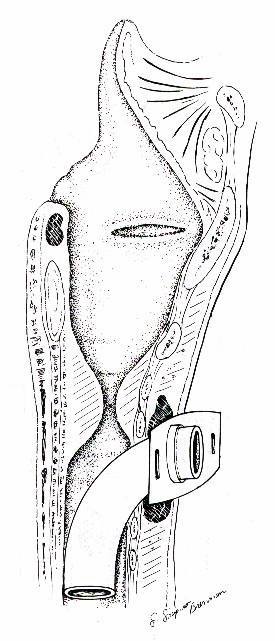
Normally speech is obtained by a steady stream of air that comes from the lungs and passes by the vocal cords as we exhale. This air is modified by the vocal cords which vibrate as the air passes through to produce sound. Speech production may be affected when a child has a tracheostomy because the trach tube re-routes all or some of the exhaled air stream away from the vocal cords.
The ability to vocalize will depend on how open the airway is and the health of the vocal cords. Medical conditions require different size tracheostomy tubes. If the tube fits snugly inside the trachea, all of the exhaled air will leave the body via the tracheostomy tube and no air will be able to pass through the vocal cords to produce speech. Children who need a ventilator often have snug fitting tubes or cuffed tubes that prevent speech. Children with smaller tubes can get air around the trach tube and by the vocal cords to create sound. If the airway is very small, scarred, or has a granuloma, the child may not be able to move enough air past the vocal cords to vocalize. If the vocal cords are scarred or paralyzed, the child’s voice may sound hoarse or unusual.
Ways to Achieve Vocalization with a Tracheostomy
- Plugging the tracheostomy tube by holding a finger or placing a cap over the tube for short periods of time.
- The child may learn to cover the trach with his/her chin or finger when talking.
- A tracheostomy speaking valve is a one-way valve that allows air in, but not out. This forces air around the tracheostomy tube, through the vocal cords and out the mouth upon expiration, enabling the child to vocalize. Speaking valves obviously cannot be used for complete airway obstruction. Ask your child‘s doctor if a speaker valve is an option for your child.
- Fenestrated tracheostomy tubes (for older children) have an opening which allows air to pass through the vocal cords.
- Electrolarynx or Artificial larynx (for older children with some experience with verbal communication) is a hand held device placed on the neck surface that vibrates when activated and mechanically resonates when words or sounds are mouthed.
- A talking tracheostomy tube. Speech is obtained through a line directly
above the cuff. An outside air source is used to force air through the vocal cords.
Aaron airway was approximately 75% occluded. He was able to uses a Passy-Muir speaking valve. When not wearing the valve, Aaron could cover his trach with his chin to talk.

Make an extra effort to talk with your child with a trach, even if he/she cannot vocalize. Read books and name objects to stimulate language development. If a child is decannulated prior to one year of age (pre-lingually) or the child can talk around the tube or with a speaking valve, speech development is usually not seriously affected by the trach. However, it is important to remember that infants and children with long-term tracheostomy tubes (6 months or longer) are at risk for language delays, including both receptive and expressive language as well as oral, speech and voice production problems. Services should be obtained from a Speech-Language Pathologist (SLP) to facilitate the child’s language development. If a child is not able to vocalize, plan for alternative methods of communication. Alternative methods include sign language, picture cards, and communication boards. The SLP can recommend the best means of communication for your child.
Children under 3 years of age in the U.S. may be eligible for Early Intervention (EI) services and can obtain home or center-based speech therapy at no cost to you. Call your local EI center and request an evaluation. For children over 3, contact your local school department for services.
 Aaron's Tracheostomy Page