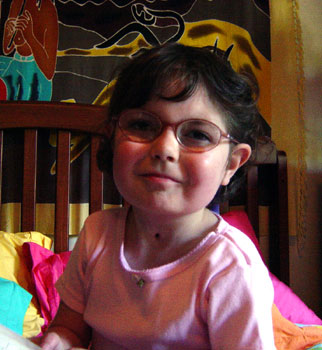
Clara Grace Chilton
Clara was born January 23, 1998, and was diagnosed shortly afterwards with tracheoesophageal fistula, esophageal atresia (TEF/EA), severe reflux and a ventricular septal defect (VSD). She had her TEF/EA repaired when she was three days old. After surgery her breathing was labored and stridorous and her ENT discovered unmoving vocal cords (thought at the time to be paralyzed, but we now know that the nerves work and so they are labeled
"fixated"). It is unknown whether this was congenital or acquired from the TEF repair.
She had a second surgery to perform a nissen fundoplication, a tracheotomy, and to place a g-tube, and then we finally got to bring her home after 9 1/2 weeks in intensive care.
Although life was better after she came home, she was very involved medically. She retched horribly during her g-tube meals, she was in mild congestive heart failure from her VSD, she was late in her gross motor development and was also diagnosed with hypotonia (low muscle tone) and micro-cornea (smaller-than-normal corneas, which causes her to be far-sighted). She grew only very slowly and her heart defect was enlarging, not closing, so she finally had her VSD repaired at 20 months old.
She did SO well after that surgery, in spite of having the complication afterwards of excess fluid around her heart. She went on Prednisone, which made her hungry, and she finally--after nearly two years of feeding therapy--started eating! The retching during her g-tube meals virtually went away. She also had less secretions and needed less suctioning.
She began to tolerate wearing a PMV (speaking valve) when she was 23 months old, and finally started walking then too. She was like a new child! Unfortunately she did have a seizure a few months after her heart surgery, and two more within one year, but she has now been seizure-free for over a year.
She got her g-tube out when she was 3 years old, and now eats everything! She had to have another surgery to close the g-tube site. She has no food restrictions as a result of her TEF/EA or trach.
Our life now with her is much easier than when she was a baby. She needs very little medical care and sometimes days go by with no suctioning. She wears a speaking valve all the time and has great language skills, though she still gets speech therapy for articulation problems. It was a long road for her to learn to use her voice after having not used her voice or her mouth for anything when she was an infant. She goes to preschool with a nurse, or sometimes with
mom. Her gross motor skills are slowly improving though we expect her to always have respiratory issues that will affect her stamina and speed because of the vocal cord problems. We are currently looking at various surgical options to possibly get the trach out before she starts kindergarten in fall of 2003.
Update, August 1, 2003 - Clara had a surgery in January of 2003 to try to open her vocal cords enough to decannulate. There's more than one way to do this, but we chose to travel to Seattle for an "Endoscopic Posterior Cricoid Split with Rib Graft" (EPCS/RG). The surgeon was Dr. Andrew Inglis at Seattle Children's Regional Medical Center.
The surgery was a success--Clara was decannulated on March 15, five years and three days after getting her trach! Our local ENT allowed us to decannulate at home, which was wonderful and stress-free.
Since then, Clara has done very well, but her voice is on the quiet side and she sometimes sounds hoarse. She can have stridor when she's active and sometimes just in certain positions. She is in speech therapy and is making great progress with her clarity and volume. She'll always have some respiratory limitations because of her abnormal anatomy, but we feel fortunate that we were able to decannulate.
She's still the same happy child that she was with the trach, only now she doesn't need a nurse when she starts kindergarten in the fall!
Trach-Free!

updated 8/1/03
|